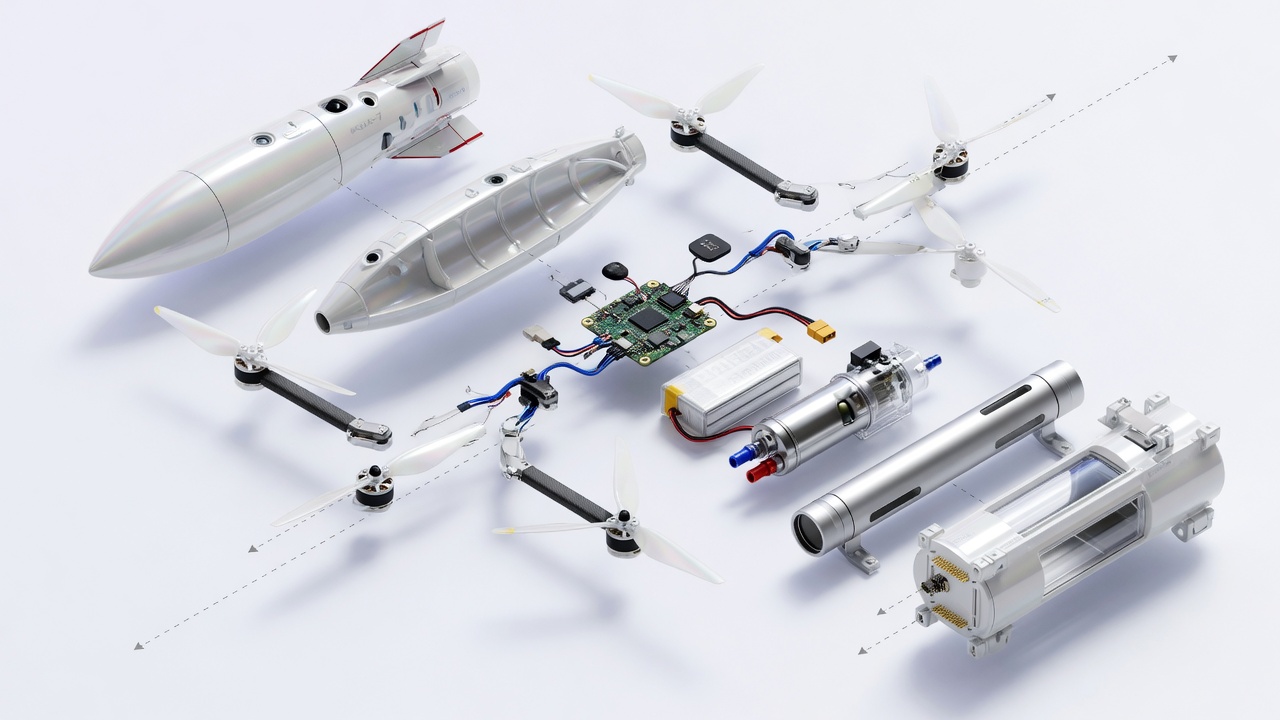
One airframe that flies, dives, swims, and surfaces. Built around a bullet hull and off-the-shelf parts, with a medium-keyed star-delta propulsion concept and a seawater range-extender. Engineered honestly: every number below is what the physics actually allows.
Speeds are in mph. For reference, the current multirotor world record is about 408 mph on a stripped racing frame with no payload, so a clean high-speed build comfortably beats Nazgul-class racers in air. A submerged bullet hull is drag-dominated, so underwater speed is far lower by design. We publish all three numbers rather than a single headline figure.
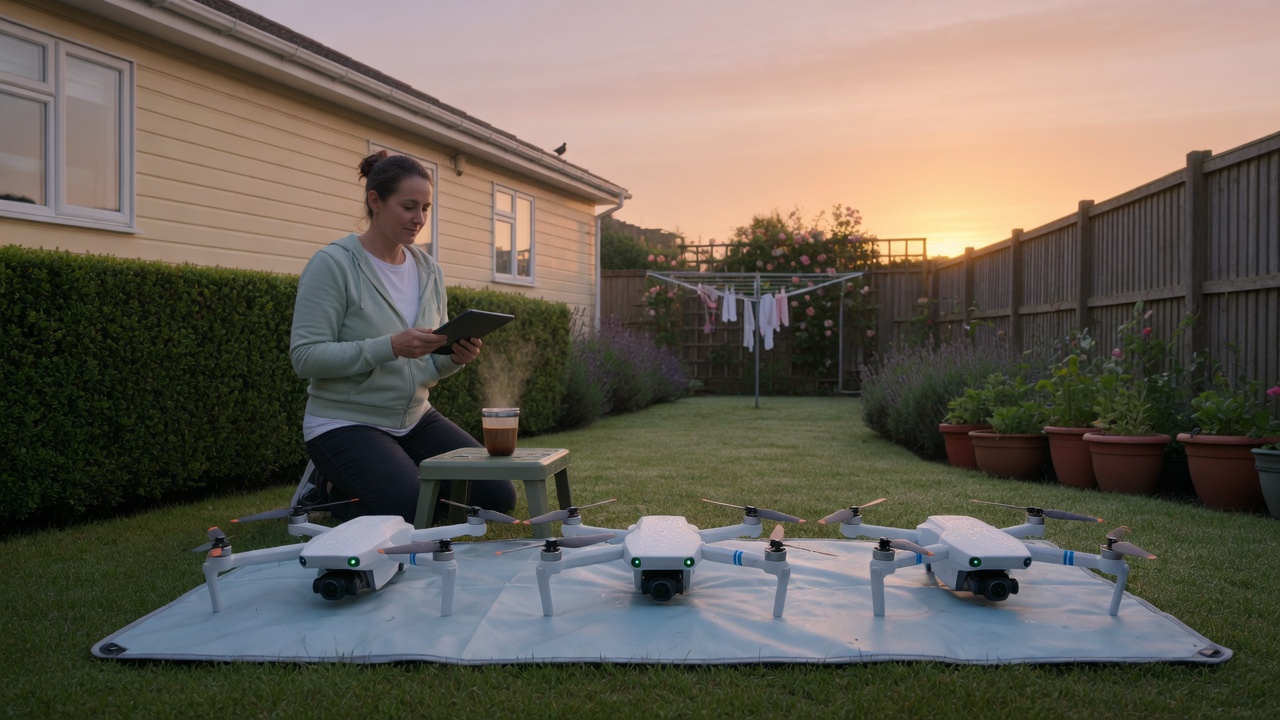
Concept visualisations of the platform and two lawful mission profiles: a capability hero reel and a maritime search-and-rescue support scene. These are design renders, not footage of a finished aircraft.
A switchable wye(star)/delta winding gives a torque-vs-speed "gear shift": star for high-torque low-speed water, delta for high-speed air. This is the keystone patent idea.
Honest build path: no hobby ESC switches windings today, so the prototype uses separate propulsors (four FPV air motors plus one or two sealed underwater thrusters). Winding-switching on a single motor is a funded research extension, not a build blocker.
An aluminium structural electrode plus a magnesium sacrificial rod forms a seawater galvanic cell. Flowing saltwater during a dive generates low-power DC.
Honest limit: roughly 5-30 W. That trickle-charges the avionics and sensor bus and extends loiter; it does not power flight. Flight energy is a 6S LiPo charged at the dock. We do not claim saltwater flight.
A buoyant bullet/torpedo hull houses a dry electronics bay. A ballast pump and depth sensor manage water entry, submerged transit, and water exit. Four folding/tilting arms carry the air rotors; a tool-less payload bay swaps mission modules.
Flotation-aid dispenser, search light, and a comms relay to mark and report a vessel's position to crewed authorities.
A servo reel with a baited sampling line, or a small scoop/landing net, for sea-pen sampling and small-catch retrieval. Sampling, not industrial trawling.
Camera and sensor survey, plus a tow-line/net module scoped to unoccupied or authority-cleared craft only.
The strongest thing a low-cost swarm can do at sea is buy time. Several buoyancy-capable drones reach a swamped or unstable boat, distribute around the hull, and hold it level and afloat to prevent capsize until a crewed rescue arrives. The same dock-and-tow mechanism recovers empty, abandoned derelict craft to the nearest safe harbour. No occupant is ever moved against their will, and people are handed to crewed authorities, not relocated by the drones.
Drones attach and add distributed buoyancy and righting support, holding a swamped hull level on the swell.
The swarm illuminates the boat and relays its exact position so a crewed coastguard cutter can take over the rescue.
Empty abandoned dinghies are a navigation and litter hazard. The swarm gently tows them to the nearest safe harbour.
When the pack runs low, the drone lands on the water and floats. A magnesium-aluminium seawater cell and a thin solar skin trickle-charge it back up over time, then it hops on. This extends range over long timescales. It is not perpetual flight, and we do not claim the sea recharges it fast enough to fly continuously.
A short hop costs roughly 10-20 Wh, so a combined ~10-50 W trickle rebanks a hop in well under an hour to a few hours of floating. Over a sunny day that is several extra hops of range with no dock. The seawater cell consumes its magnesium electrode as it runs, so it is a finite range-extender, not free energy.
A light aramid-composite skin over the bullet hull resists impact, abrasion, sea state, salt corrosion, and fragmentation, and sheds spray on water entry.
Sealed dry bay, conformal-coated boards and glanded penetrations let it fly through driving rain and spray and operate in cold, wet, salt-laden air.
A flyable craft of around 1.5 kg cannot carry rifle-rated (NIJ III/IV) armor, which is kilograms of steel or ceramic. We do not claim it stops rifle rounds. The skin is for durability and fragmentation, not ballistic protection.
A genuine localisation path: the airframe, sealing, integration and a large share of the electronics can be UK or EU built. We are honest that some inputs are globally China-dominated and cannot be fully localised today.
PCB-as-structural-airframe: rigid boards double as load-bearing arms and bulkheads while carrying the power electronics, cutting part count and mass (load-limited, suited to a small craft, sealed and conformal-coated). UK-sourced 6061 aluminium tube and magnesium anode stock, a uniframe body, local SMD assembly and motor winding, and final integration.
NdFeB motor magnets, many semiconductors, and lithium cells are China-dominated worldwide. A realistic first build localises the structure, assembly and integration and a meaningful slice of components, while these specific inputs remain imported. We will not claim zero reliance when the supply chain does not support it yet.
Indicative mid-2026 prices in USD. Treat as ballpark, not quotes. A bundled BNF FPV quad collapses the air-side lines into one purchase, which is the fewest-components route.
| # | Part | Qty | Line USD | Function |
|---|---|---|---|---|
| 1 | RC submarine hull (bullet/torpedo, ABS, hobby grade) | 1 | 90 | Buoyant body, dry electronics bay |
| 2 | Flight controller + 4-in-1 ESC stack (F405/F722, 45-60A) | 1 | 65 | VTOL stabilisation, drives 4 air motors |
| 3 | Air motors, 2207-class brushless (IP53 splash) | 4 | 60 | VTOL lift and thrust in air |
| 4 | Air props (5 inch) + spares | 8 | 8 | Convert motor torque to lift |
| 5 | Sealed underwater thruster (U-series) + bidirectional ESC | 1-2 | 140 | Dedicated water propulsion |
| 6 | 6S LiPo packs (1300-2200 mAh) | 2 | 65 | Primary flight and thruster energy |
| 7 | 6S balance charger | 1 | 45 | Charges packs at the dock |
| 8 | ELRS 2.4GHz receiver (nano) | 1 | 12 | Long-range control link |
| 9 | ELRS radio transmitter | 1 | 100 | Pilot control |
| 10 | FPV camera + VTX kit | 1 | 40 | Live video (air phase) |
| 11 | Ballast pump (12V) + reservoir | 1 | 20 | Dive and surface control |
| 12 | Depth / pressure sensor (MS5837-class) | 1 | 22 | Depth feedback for ballast |
| 13 | Waterproof servos (metal gear, 20 kg) | 2 | 56 | Ballast valve / payload actuation |
| 14 | Aluminium tube (6061, frame) | 1 set | 22 | Booms/arms; the Al galvanic electrode |
| 15 | Magnesium sacrificial-anode rod | 1 | 20 | The Mg electrode for the aux cell |
| 16 | Wiring / connectors (XT60/XT30, silicone wire) | 1 set | 20 | Power and signal interconnect |
| 17 | Marine epoxy + conformal coating spray | 1 set | 25 | Seal penetrations, protect PCBs |
| 18 | Payload-bay hardware (servo reel, net/scoop, line) | 1 set | 35 | Swappable mission modules |
| 19 | O-rings, bulkhead glands, cable penetrators | 1 set | 18 | Waterproof every wire penetration |
| Indicative subtotal | ~$880 | Swing range ~$700-$1,300 | ||
Honest caveats: hobby "torpedo" hulls are usually static-dive ABS kits, fine for shallow prototype depth but not deep-rated. "Waterproof" FPV motors are IP53 (splash), not submersible, which is why water propulsion uses dedicated sealed thrusters. Full sourcing, IP ratings, and citations are in the engineering dossier in the repository.
Four live tools, all deterministic and honest. Change one input and the totals, the power budget, and the propulsion mode cascade.
A taste of the programmable board (patent DF24-05). Type a plain-language brief; it compiles to a validated parameter set with safety interlocks. Deterministic, runs in your browser. The real board compiles to flight-controller params.
Hop, float, trickle-charge, hop again. Honest math: the sea and sun extend range, they do not power continuous flight.
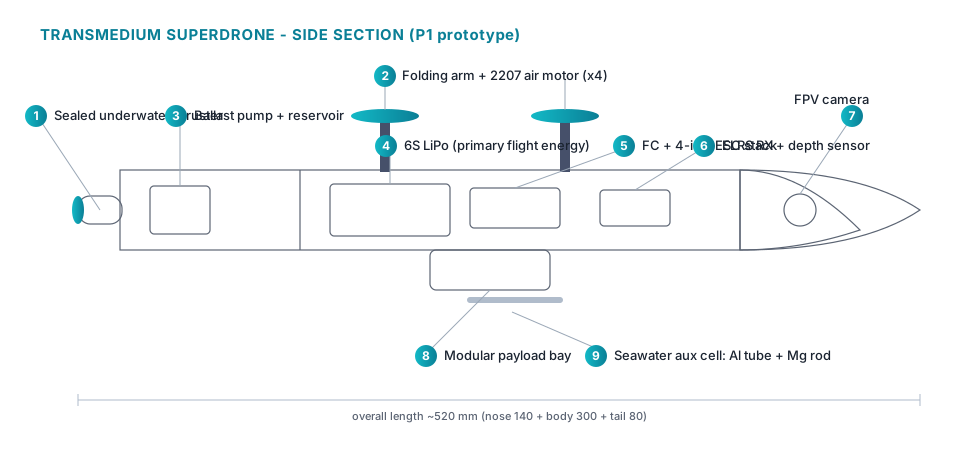
Designed so a prototyping shop can assemble it with a screwdriver, a hex set, a soldering iron, and a butterknife for prying the hull halves. STEP files and per-step illustrations ship in the repo.
freecadcmd build_step_skeleton.py), and this labelled schematic, so a shop can model and
quote the prototype. The STEP skeleton is primitive layout geometry, not production parts.
A dependency-ordered checklist from parts on the bench to a fundable demonstrator. Each step unlocks the next.
Six AI-assisted draft applications covering the transmedium platform: medium-keyed star-delta propulsion, the seawater auxiliary range-extender, transmedium hull integration, the modular payload bay, natural-language mission programming, and a lawful maritime search-and-rescue support swarm method. Prepared for UK IPO and Irish (IPOI) filing. None of these is a granted patent; professional prosecution by a qualified patent attorney is required before any rights exist.
Everything a prototyping shop needs to quote and build, plus the draft patent bundles.
Specs, BOM, assembly steps, dimensions, safety and legal, on two printable pages.
All 19 lines with quantities, prices and AliExpress search terms, ready for a spreadsheet.
A real STEP layout (also available as STL) to import and model against. Generator scripts are in the repo. Primitive layout, not production parts.
Nominal dimensions, mass budget, electrode and penetration detail.
Labelled side section mapping every numbered component.
Six draft specifications and the downloadable filing bundles. Drafts, not granted.
Pusterla Elektronik AG - the genuine Zurich walk-in component counter, Kernstrasse 55, 8004 Zurich. Distrelec and Conrad are next-day delivery (Conrad's Swiss stores closed in 2021). Play-Zone (Zug) and Bastelgarage cover maker parts online.
FabLab Zurich (Zimmerlistrasse 6) for laser, CNC, 3D print, and an electronics bench. Bitwaescherei and the co-located SGMK MechArtLab (Neue Hard 12) for hardware hacking. Low-volume PCB via Eurocircuits or PCB Runner.
Confirm 2026 opening hours before visiting; some listings predate this year.
An amphibious prototype from off-the-shelf parts sits around TRL 3-5. Grants fund the differentiator (the air-water transition, autonomy, payload), not the assembly. We are the applicant, not a raiser of third-party capital.
Defence and Security Accelerator. Typically GBP 100k-350k, themed maritime and security competitions plus a rolling open call. Expects a prototype demo near TRL 6-7 within about 12 months. Reasonable odds with a specific maritime problem and a defensible differentiator.
DfT money via Innovate UK. Feasibility strands are the most accessible entry. Tie the platform to a clean-maritime use case such as emissions monitoring, port efficiency, or survey replacing crewed vessels.
Retrospective credit on qualifying R&D spend, no competitive panel. Refunds money already spent rather than funding up front, and the scheme has tightened, but it is the most reliable route for a genuinely novel prototype.
Innovate UK Smart Grants were the historical best fit but were paused in January 2025. Watch for the replacement scheme rather than planning around them today.
Written in the voice of a first-principles engineer looking back. It is a thought exercise, not a claim about the future. The leverage is always the same: collapse part count, make the structure do two jobs, and make every connection impossible to get wrong.
A modular FPV core already cut ~120 parts to ~85. Monocoque + potted modules can halve assembly time. Every deleted part is a deleted failure mode.
Rigid boards carry both load and current; copper planes spread heat; the frame is the wiring. Load-limited, but for a small craft it removes brackets, harness and mass.
Keyed, colour- coded, polarity-locked connectors; one-orientation modules; a wiring diagram printed inside the hull. The build cannot be done wrong, so an untrained person can repair it.
Two halves, one O-ring seam, snap-fit captive clips (a butterknife pries it open). Molded-in inserts and mounting bosses; no loose nuts. ~2 minutes to open and close.
Flight controller + 4-in-1 ESC + BEC + receiver, conformal-coated and potted, keyed so it only fits one way. Swap the whole brain in under 90 seconds, no soldering.
Motor pods on a single captive bolt with pre-soldered quick-disconnect leads; battery on a keyed XT60 that cannot go in backwards. Field-swap in minutes.
Pop-out wings deploy after vertical take-off so it cruises on the wing, not the rotors. This is the variant that does a 30-mile (48 km) inspection roundtrip; an efficient VTOL/fixed-wing hybrid is a ~200 km class. Borrows benign airframe ideas (folding wings, low sea-skimming cruise, compact bullet form).
~20-25 kg all-up (UK HSE single-person lift guidance ~25 kg), ~5-15 kg payload. Folds and carries under one arm for rapid SAR and inspection from anywhere.
A large multi-rotor for ~100 kg payload (delivery, equipment, agriculture). Honest: at this size it is moved by trolley or two people, it is not "one-person lift".
Tesla announced a next-generation drive in 2023 with no rare-earth permanent magnets. Switched-reluctance and wound-field motors do the same: no neodymium, robust, and immune to magnet demagnetization. For us that means supply-chain sovereignty and longevity. The honest catch is below.
| Property | NdFeB PM BLDC (default) | Magnet-free (SRM / wound-field) |
|---|---|---|
| Power density | High | Lower for the same size (the real cost) |
| Control | Mature, simple | Harder (more torque ripple, complex drive) |
| Rare-earth dependence | Yes (China-dominated NdFeB) | None |
| Longevity / demagnetization | Can demagnetize when hot | No magnets to lose; robust |
| Best for | The everyday lightweight build | Sovereignty / longevity variant |
So "superior power and longevity" is not the full truth: it is superior longevity and supply independence with a power-density cost. We offer it as the rare-earth-free variant; the default build stays PM BLDC.
Indicative material and process costs to wind a 2207-class motor locally (mid-2026, verify against live quotes). The point is that the structure, winding, PCB and assembly are genuinely UK-makeable.
Motor winding/rewinding, PCB fab + SMT assembly, CNC machining, carbon-composite / injection moulding, aluminium tube, lithium packs + BMS. Find reliable SMEs via Made in Britain, the MTC, and local enterprise partnerships, and run two suppliers per part in tandem for resilience.
NdFeB magnets, lithium cells, and most semiconductors are China-dominated worldwide. A first build localises structure, winding, PCB and integration plus a meaningful share of parts; these specific inputs stay imported until the supply chain matures (the magnet-free variant removes the magnet dependency).
C60 (buckminsterfullerene) earns its place in the composite hull and coatings, not in the battery and not as a health product. Adding 0.1-2 wt% to the epoxy is a documented, low-cost upgrade.
0.1-2 wt% C60 in epoxy: impact strength up ~50-200%, tensile +15-25%, modulus +10-50% in lab studies (oxidized C60 best).
C60/epoxy coatings stay intact through 200+ hours of salt-spray testing, useful for a marine drone.
As a lubricant additive, friction down ~4-20% in lab tests. Minor, optional.
Indicative market values (sourced, 2025-2026), not guarantees. Filter by category. Aquaculture and SAR support are the standout recurring earners for Ireland and the UK.
| Use case | Category | Who pays | Indicative value | IE/UK fit | Note |
|---|
Speculative items (aquaculture per-job, SAR pricing) are flagged. "Fit" reflects how winnable it is for an Ireland/UK SME today.
| # | Niche | Incumbent cost | Drone cost | Barrier | Real? |
|---|---|---|---|---|---|
| 1 | Aquaculture net/pen/mooring (IE + Scotland) | diver £5-8k, vessel £22-32k/day | £2-3k | Low, recurring, no reg barrier | Strong |
| 2 | Offshore-wind foundation/scour/J-tube (UK) | ROV+vessel £25-40k/event | £5-8k | Needs DNV/class cert | Strong (post-cert) |
| 3 | Subsea cable landing / shallow survey | $500k per fault | £2-4k | Budget weak (laid + forgotten) | Niche |
| 4 | Port hull / quay-wall / IMO biofouling | diver £4-6k/day | £1.5-2.5k | Crowded, thin margins | Partial |
| 5 | Coastal / seagrass / outfall / flood-defence | manual / irregular | £1-2k | Govt budget cycles | Aspirational |
Start with aquaculture: farms already use underwater drones, diver inspection is genuinely expensive and unsafe in rough water, and the revenue recurs (4-12 inspections per site per year).
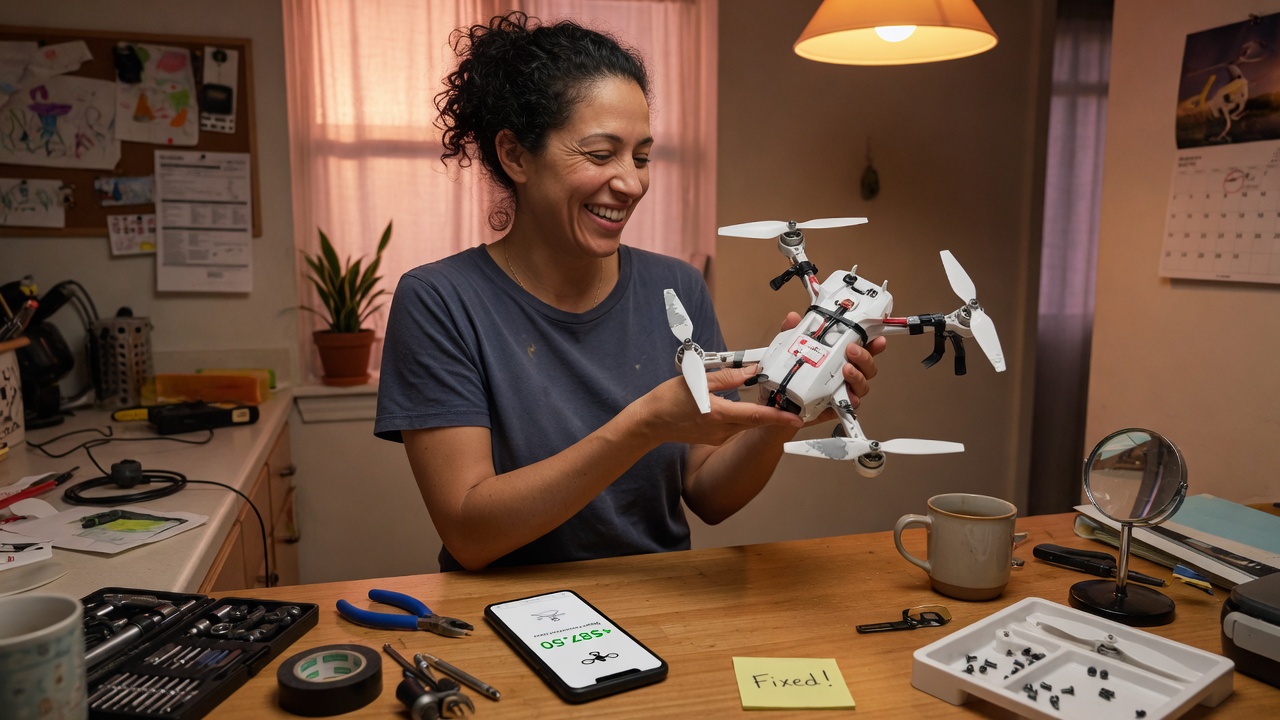
A drone does paid work - inspection, survey, search-and-rescue support - and the household that maintains it shares in what it earns. Anyone can learn the common swaps; the income and the skills stay local. One well-kept drone becomes two, then a small fleet that quietly helps keep the country running.


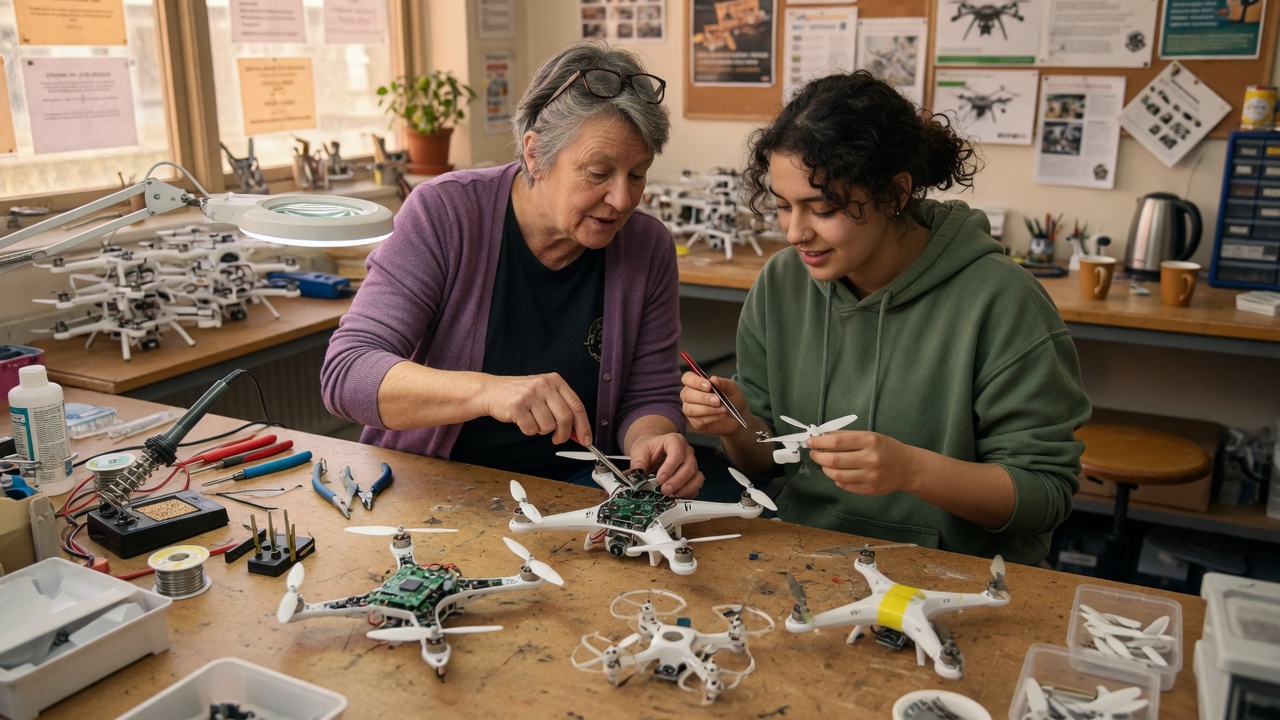
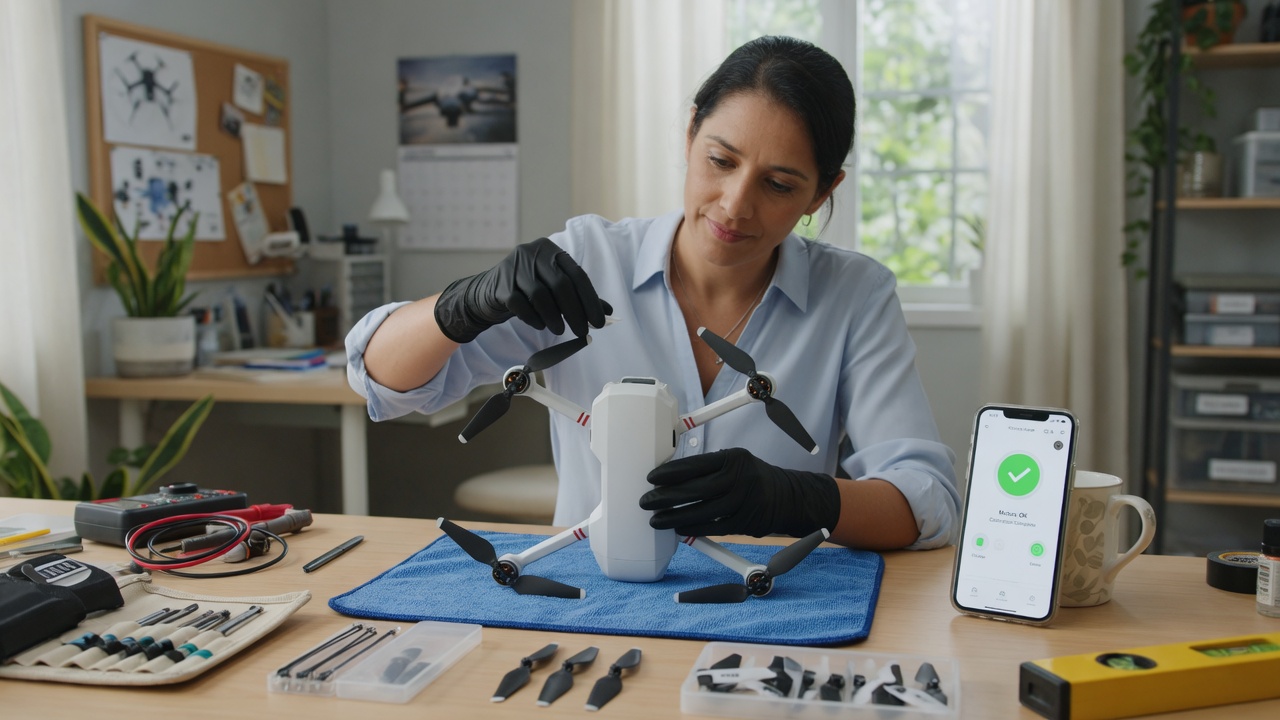
Because the drone is modular and error-proofed, an untrained person can do the common repairs with guided, repetitive, encouraging steps (scan the arm's QR, follow photos, run the one-touch motor test). A grounded drone costs an operator about $480/hr, so fast local repair has real value.
Prop swap, battery swap, motor-pod / arm swap (pre-soldered), antenna swap, connector re-seat, frame straighten, O-ring re-grease, and visual QC (voltage check, spin test, balance check). Guided by an app that will not let you skip a safety step.
Waterproof re-test (slow leaks need a long soak), flight-controller / compass calibration, ESC firmware reflash, and any cell-level battery work. These are safety-critical and need a bench, so the hub does the final flight + leak test before return.
Honest economics: small networks are break-even; profitability comes from stacking local nodes + parts margin + a subscription, not labour arbitrage alone. The aggregator carries product liability; the home repairer's liability is capped to the part.
Operator ID (£12.34/yr) + Flyer ID (mandatory from Jan 2026), UAS registration + Remote ID, Specific Category Operational Authorisation (PDRA01 ~£524/yr for VLOS; UK SORA for BVLOS), GVC/RPC pilot competency, and the new UK class marks (UK0-UK6, mandatory on new drones from Jan 2026). Routine BVLOS is on the CAA roadmap to ~2027.
ISO 9001 and ISO 21384 (UAS design/ops), UK GDPR + a DPIA for any survey imagery of people, and Cyber Essentials (effectively required for government contracts).
DASA / Defence Innovation Loans (SMEs, TRL 6+, up to £1M), Innovate UK and the Clean Maritime competition, and open tenders via Contracts Finder / Find-a-Tender (with a ~10-25% social-value weighting). Smart Grants are paused.
Interface with HM Coastguard / MCA as a support asset (the MCA Drone Pathfinder explores BVLOS in unsegregated airspace). Drones complement, they do not replace, crewed rescue, consistent with the SOLAS duty to rescue.
A thermal drone is airborne in ~5 minutes, covers an area dozens of ground searchers could not, and finds heat signatures through darkness and light cover. It speeds detection and dispatch; the physical rescue stays with crewed teams. Figures are from cited field studies, not invented multipliers.
A cheap balloon lifts a small relay to the edge of space to watch a wide area and pass data down to the drones and ships below. The honest catch is what "cheap" buys you.
A sounding balloon climbs to ~30 km and bursts; the payload parachutes back. Hours of wide-area data and relay per flight, not indefinite loiter. Perfect for cheap, repeatable high-altitude passes.
For station-keeping you need a super-pressure balloon (Loon flew ~100 days) or a solar HAPS (Airbus Zephyr set a 67-day solar record). Costlier, but genuinely persistent.
Above cloud at 18-25 km, solar is ~1.1-1.25 kW/m2 (vs 0.2-0.8 at a cloudy surface), so a solar platform recharges well by day to fly through the night.
The hop-and-loiter drones, balloons and buoys carry MeshCore (an open LoRa mesh, up to 64 hops). At the sea surface a hop is short; lift the relay and the radio horizon explodes.
| Relay height | Radio horizon (two equal nodes) | What it means |
|---|---|---|
| 0.5 m (sea surface) | ~2.9 km | Dense nodes needed |
| 100 m (mast / low drone) | ~82 km | Covers a bay |
| 1 km (high drone) | ~261 km | Covers a coastline |
| 20 km (balloon) | ~1,168 km | One balloon links a whole sea area |
A coastal or EEZ mesh is very doable with a few elevated relays. A full trans-Atlantic always-on surface mesh is not: the gaps need altitude relays plus satellite backhaul. We are honest about that.
Real comparators: the US Navy "Lightfish" solar craft logged ~7,500 miles in 150 days; Saildrone USVs have passed a million nautical miles. A hop-float-hop drone can chain across an ocean over months, but biofouling is the number-one limiter (marine growth adds drag within weeks), then battery wear and weather. We do not claim indefinite self-powered flight.
A UK-built network that watches over its own waters: a peaceful mesh of monitoring drones, buoys and high-altitude relays supporting safety, the environment and industry across UK waters and the EEZ. Sovereignty and stewardship, not conquest. International waters belong to no one.
Faster detection and a live picture for HM Coastguard, supporting crewed rescue.
Outfall, spill, seagrass and water-quality monitoring along the coast.
Aquaculture, offshore-wind and cable infrastructure, and port inspection: the recurring blue-economy work.
Where the parts can actually be made in the UK. Real, verifiable firms and the high-value manufacturing catapults. Honest about where UK capacity is thin (motors, cells).
Capacity context (sourced): total UK drone throughput today is ~500-1,000/month; UK motor winding tops out ~2,000/month and there is no domestic lithium-cell manufacturing. Figures are indicative planning estimates.
The dream is a lights-out factory run by one person. The honest version is a highly automated line that still needs a small team, and it is genuinely buildable in the UK.
Runs ~30 days unmanned, ~6,000 robots/month, but still needs engineers for maintenance and exceptions. That is the bar.
Waterproof re-test, flight test and rework stay manual. A small line is highly automated, lights-out-capable for stretches, not zero-touch.
A small automated line runs ~500-1,000 units/month at ~100-200 units per person, vs ~10-20 manual.
| Process | Machine | Makes | Indicative capex |
|---|---|---|---|
| Winding | Automated coil winder | Motor stators | $5-20k |
| Moulding / CNC | Injection press / CNC | Propellers, frames, endcaps | $35-200k |
| PCB assembly | SMT pick-and-place + reflow | Flight controller, ESC | $90-280k |
| Inspection | 3D AOI | Solder-joint QA | $50-200k |
| Battery | Cell-to-pack + BMS | Packs (cells imported) | $40-80k |
| Sealing | Potting / conformal coat | Waterproofing | $15-50k |
| Assembly | Final-assembly cobot | Screw, bond, fit | $40-150k |
| Test | Motor + flight/EOL rigs | Thrust, leak, flight QA | $95-250k |
| Turnkey line (machines + integration + MES) | ~$0.7-1.4M | ||
AESC Sunderland makes pouch cells (live); Agratas Somerset pilots in 2026; Britishvolt failed; Batri made a sodium-ion 18650 demo. No UK Li-ion 18650 at scale yet, so cells are imported. LiPo is right for this drone.
The bullet hull cuts from pre-approved 6061 aluminium tube (~GBP25-50/m, Smith Metal, ThyssenKrupp) or carbon (~GBP40-100/m): easy to cut, no moulds, aerospace-grade, minimal lead time.
A UK-assembled BOM is ~GBP190-355 vs ~GBP120-200 for a China ready-to-fly: a ~50-80% premium that buys sovereignty, jobs and resilience.
Every figure here is the honest one from the research, with its caveat. The video is the cinematic wrapper; these charts are the accurate data.